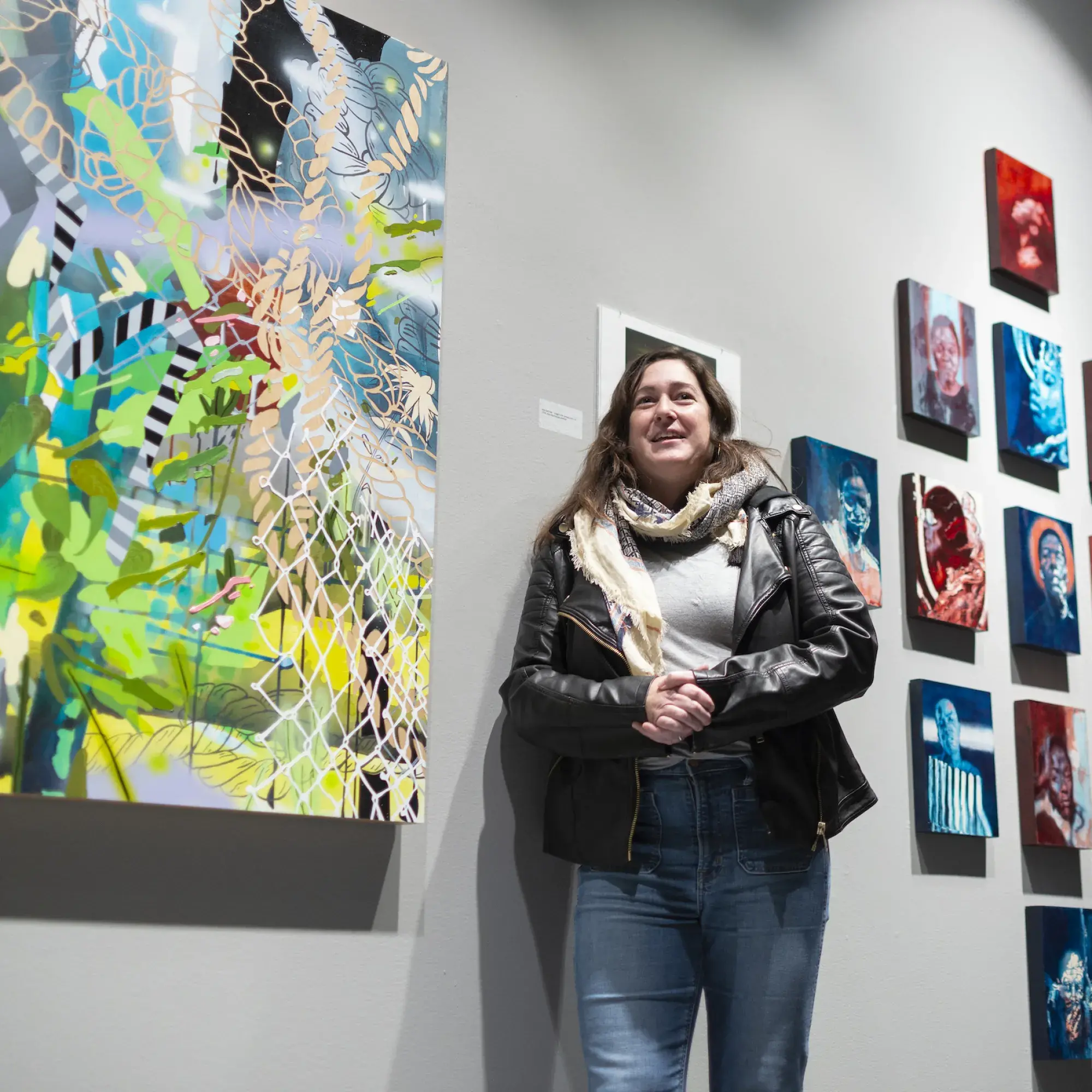
Woman wearing jeans and leather jacket standing in front of art exhibit

Professional Networks

Get connected. Be inspired.

students and faculty talking

At Lesley, we’re committed to building networks that provide alumni and professionals in the field with vibrant communities for learning, collaboration, and mentorship, and for connecting with the world-class employers that partner with Lesley

Lesley’s Communities of Practice and Alumni Cohorts are how we’re delivering on that commitment. Communities of Practice are small, interest-driven groups organized by professional area, providing members with access to workshops, networking events, mentorship and support, and a range of interdisciplinary projects. They are a chance for experts in specialized fields to collaborate, exchange ideas, and support each other both personally and professionally.

Additionally, our alumni cohorts grow in response to the needs and interests of our alumni. Alumni cohorts are an ideal way for graduates of Lesley to stay connected to their community, and provide a unique space and opportunity to grow, thrive, and belong. 

students sitting at a table together smiling

Explore how we are creating and fostering opportunities and connection across our different focus areas.

Education

Professional Networks

Community of Practice for Experienced Educators: Exploring the Impact of Trauma & Cultivating a Sense of Belonging for All

Session Descriptions & Objectives

Micro-credentials: Badges + Certificate/PDP

  • Digital badge for each session: Participants receive a badge (micro-credential) after completing each individual session.
  • Certificate of Completion: Participants who complete all four sessions receive a Certificate of Completion recognizing full participation in the Community of Practice series.
  • Participants will be eligible to receive PDPs upon completing all four sessions and the required two hours of asynchronous work.

Facilitator
Theresa Melito-Conners, '19, PhD Educational Leadership
Dr. Theresa Melito-Conners, a graduate of Lesley University, is a special education administrator in Melrose and the founder of Dr. MC’s Self-Care Cabaret (2019), a platform offering workshops, a podcast, and educational curricula. She holds a doctorate in educational leadership, is a licensed K–12 counselor, and earned both a master’s of education in school counseling and a B.A. in theater studies. In 2022, she was honored with Lesley’s Sally K. Lenhardt Professional Leadership Award. A recognized MA DESE PDP provider, her writing has been featured in ASCD’s Educational Leadership Magazine, Edutopia, Exceptional Parent, NAA, and School Administrator’s Magazine. She also fosters a growing online community @DrMCselfcare. Blending education, wellness, and the arts, her work champions sustainable self-care for educators, professionals, and students alike.

This session focuses on the personal sustainability of the experienced educator. We will examine the professional necessity of self-care and resilience, exploring how the demands of the modern educational environment lead to burnout and vicarious secondary trauma. Participants will acquire practical strategies for setting professional boundaries and cultivating work-life balance to ensure longevity and effectiveness.

Objectives:

  1. Identify personal indicators of stress and secondary vicarious trauma impacting professional performance.
  2. Develop effective, realistic strategies for establishing and maintaining professional boundaries.
  3. Reflect on the necessary connection between educator well-being and a positive, trauma-informed school environment.

Moving beyond the individual classroom, this session explores implementing trauma-informed practices at the school or district level. The goal is to collaborate on strategies that create consistent, predictable, and supportive school environments that genuinely foster belonging for all.

Objectives:

  1. Analyze the systemic barriers to creating a truly trauma-informed and equitable school culture.
  2. Collaborate on strategies for aligning school-wide policies, including those for Special Education, with trauma-sensitive principles.
  3. Generate proposals for systemic changes that enhance safety and predictability for all students and staff.

This session delves into the critical role of equity and identity in fostering a true sense of belonging for every student. We will explore how cultural backgrounds, race, and unique identities intersect with educational systems. Participants will focus on identifying systemic inequities and developing actionable strategies to refine their practice, curriculum, and advocacy efforts to ensure all students feel valued and seen.

Objectives:

  1. Examine the influence of student and staff identity on the climate and culture of the school environment.
  2. Refine professional practices using an equity-focused lens to support all students, particularly those who have been historically marginalized.
  3. Articulate key areas for professional and school growth related to inclusive practices and anti-racism in education.

This final session focuses on empowering participants to leverage their expertise as leaders within their schools and districts. The session culminates in developing personal action commitments to ensure the learnings from the year translate into continuous professional growth and lasting impact.

Objectives:

  1. Identify opportunities for informal and formal leadership within their current roles to drive systemic improvement.
  2. Develop a personal plan for translating the year’s learning into tangible, sustained professional action.
  3. Determine strategies for maintaining personal resilience and passion while leading complex change efforts over a long career.

Dates and times

Session Dates Time Registration (Alumni only) Registration (General Public)
1 February 26 6:00 - 8:00 pm EST Alumni Register here General Public Register here
2 March 19 6:00 - 8:00 pm EST Alumni Register here General Public Register here
3 April 2 6:00 - 8:00 pm EST Alumni Register here General Public Register here
4 April 30 6:00 - 8:00 pm EST Alumni Register here General Public Register here

Communities of Practice cost $75 for Lesley alumni and $100 for non-alumni participants per session.

Participants will be eligible to receive PDPs upon completing all four sessions and the required two hours of asynchronous work.

Watch the Trauma and Belonging Microlearning

Mental Health & Well-Being

Professional Networks

Professional Network + Leadership Development HUB for Mental Health Professionals

Micro-credentials: CEs+ Badges + Certificate

  • Digital badge for each session: Participants receive a badge (micro-credential) after completing each individual session.
  • Certificate of Completion: Participants who complete all four sessions receive a Certificate of completion recognizing full participation in the Community of Practice series.
  • Session 1: Post-Grad Roadmapping + Sustainable Practice (Supervision, Goals, Burnout Prevention). This program is approved for 2 CEs through Lesley University Mental Health and Well-Being, an NBCC Approved Continuing Education Provider (ACEP No. 4472).

Facilitator
Jon Cunha, '13 MA in Clinical Mental Health Counseling: School and Community Counseling Specialization
Jon Cunha, LMHC, is a recognized leader in male mental health domain with 15+ years of experience. As Founder of Riser+Tread, LLC, he has built innovative programs that empower young men through therapy, coaching, and group experiences designed to strengthen resilience and performance. Beyond private practice, Jon focuses his attention on supporting the communities in which he serves through mentoring the next generation of clinicians, volunteering time to underserved populations, and teaching at local universities such as Boston University. His mission grounding mission is to break down the stigma of men seeking mental health support, provide trusted guidance, and create spaces where young men can step up, move forward.

This program is approved for 2 CEs through Lesley University Mental Health and Well-Being, an NBCC Approved Continuing Education Provider (ACEP No. 4472).

Outcomes:

  • Clarify next-step career goals using a simple roadmap that integrates personal and professional priorities.
  • Apply the 3 P’s framework (Product, Process, Purpose) to define what you do, how you work, and why your work matters.
  • Identify early warning signs of burnout and select proactive self-care strategies that support long-term effectiveness.
  • Build a practical self-care plan across key domains (awareness, balance, flexibility, physical health, social support, mindfulness/spirituality).
  • Name common clinical/workplace stressors (emotional load, ambiguous structure, slow client change) and choose strategies to manage them while protecting clinical presence.

Outcomes:

  • Define an ideal client and identify realistic community pathways to reach them.
  • Create a Top 100 outreach list and draft a short, authentic message that communicates your mission and services clearly.
  • Identify and prioritize access points (people/places/organizations) that connect to your ideal client population.
  • Set up a lightweight system to track referral sources so you can focus outreach where it is working.
  • Use a simple outreach routine (reach out → schedule a 15–20 minute connection call → follow-up) to strengthen relationships and generate consistent leads.

Outcomes:

  • Describe leadership styles often used in clinical environments (autocratic, democratic, holistic/laissez-faire, mindful) and recognize strengths and risks of each.
  • Identify your current default leadership style and connect it to your values, identity, and professional context.
  • Practice selecting (and switching) leadership approaches based on situational needs, team dynamics, and the type of support required.
  • Develop a personal leadership statement that supports future roles (supervisor, director, clinical lead) while avoiding one-size-fits-all habits.
  • Build language for giving feedback and creating structure while protecting trust and morale.

Outcomes:

  • Map a realistic lifespan view of your clinical career—what to build, shift, add, or release over time.
  • Assess sustainability of full-time direct practice long-term and identify alternative pathways that align with your clinical identity.
  • Name 2 to 3 growth directions (supervision, leadership, consulting, program development, teaching/training) and outline first steps toward them.
  • Use peer dialogue to clarify what energizes you (and what depletes you) and translate that insight into an actionable plan.
  • Leave with a personalized set of next moves that align well-being with professional goals.

Dates and times

Session Dates Time Registration (Alumni only) Registration (General Public)
1 February 9th 12:00 - 2:00 pm EST Alumni Register here General Public Register here
2 March 2nd 12:00 - 2:00 pm EST Alumni Register here General Public Register here
3 April 6th 12:00 - 2:00 pm EST Alumni Register here General Public Register here
4 May 4th 12:00 - 2:00 pm EST Registration to come Registration to come

Communities of Practice cost $75 for Lesley alumni and $100 for non-alumni participants per session.

Watch the Microlearning

Art & Design

Professional Networks

Community of Practice: Studio Futures: Tech & Tactics for Contemporary Practice

Micro-credentials: Badges + Certificate/PDP

  • Digital badge for each session: Participants receive a badge (micro-credential) after
    completing each individual session.
  • Certificate of Completion: Participants who complete all four sessions receive a
    Certificate of Completion recognizing full participation in the
    Community of Practice series.
    PDP eligibility: Participants will be eligible to receive PDPs upon completing all four
    sessions and the required two hours of asynchronous work.

Facilitator
Hanah Cincotta, '22, BFA, Animation
Hanah Cincotta is an award-winning 2D animator and artist whose work has been shown at many international film festivals and exhibits, most notably her award-winning short film, O’o: The Last Voice of Kauai. Since graduating from Lesley University in 2022 with a BFA in Animation, Hanah has lent her diverse skill set in 2D animation and artistry to clients, including independent artists, video production companies, non-profits, museums, and biotechnology companies. With a deep fascination and enthusiasm for 2D animated storytelling and the natural world, Hanah hopes to both entertain and educate her audience through her work.

Dates and times

Session Dates Time Registration (Alumni only) Registration (General Public)
1 February 21 1:30 - 3:30 pm EST Alumni Register here General Public Register here
2 March 21 1:30 - 3:30 pm EST Alumni Register here General Public Register here
3 April 18 1:30 - 3:30 pm EST Alumni Register here General Public Register here
4 June 6 1:30 - 3:30 pm EST Alumni Register here General Public Register here

Communities of Practice cost $75 for Lesley alumni and $100 for non-alumni participants per session.Watch the Studio Futures Microlearning

Analyzing sophisticated hybrid practices that blend traditional and digital methodologies, and creating innovative portfolio presentations that showcase technological fluency while highlighting unique creative visions.

Outcomes:

  • Analyze advanced techniques for combining traditional and digital creative processes.
  • Create implementation strategies for hybrid practice development and client communication.
  • Develop strategic portfolio presentation methods that demonstrate technological
    sophistication.
  • Building competency in contemporary portfolio platforms and presentation technologies.

Achieving mastery of emerging creative technology tools, advanced platform utilization, and strategic tool selection for maximum creative and professional impact.

Outcomes:

  • Evaluate emerging creative technology tools relevant to individual practice areas.
  • Develop strategic technology adoption frameworks for continuous innovation.
  • Build collaborative networks for tool sharing, learning, and creative technology advancement.
  • Design sustainable approaches to continuous learning and technology integration.

Building sustainable, economically viable creative careers that leverage technological fluency, developing leadership capabilities in creative technology adoption, and establishing pathways for ongoing professional growth and industry influence.

Outcomes:

  • Synthesize year-long learning into comprehensive creative career sustainability strategies.
  • Develop leadership capabilities for creative technology adoption and industry influence.
  • Establish sustainable economic models that leverage technological fluency and creative
    expertise.
  • Create mentorship and knowledge-sharing frameworks for ongoing creative community
    development.

Understanding and integrating artificial intelligence tools into traditional creative practice, exploring ethical considerations, and maintaining artistic integrity while leveraging technological advancement.

Outcomes:

  • Analyze current AI tools available for various creative disciplines and their practical
    applications.
  • Identify strategies for integrating AI workflows while maintaining creative authenticity, ethical
    practices, and personal style.
  • Establish technology integration goals aligned with individual creative practice and career
    objectives.
  • Develop frameworks for ethical AI use in creative work and intellectual property
    considerations.